
Former Bangladesh Prime Minister Khaleda Zia is in an 'extremely critical' condition, according to her personal physician. She has been hospitalized since November 23 for multiple health complications and is currently on ventilator support.

External Affairs Minister S Jaishankar conveyed the condolences of the people of India and the government to Tarique Rahman, Khaleda Zia's elder son.

External Affairs Minister S Jaishankar handed over a letter from Prime Minister Narendra Modi to BNP leader Tarique Rahman, conveying condolences after the death of former Prime Minister Khaleda Zia. Jaishankar's visit comes amid existing tensions between India and Bangladesh.
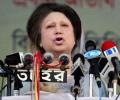
Khaleda Zia, Bangladesh's former first female prime minister and chairperson of the Bangladesh Nationalist Party, has died at the age of 80 after a prolonged illness.

Security has been tightened around former Bangladesh prime minister Khaleda Zia as a medical team from China arrived to assist in her treatment. Zia is in critical condition at a private hospital in Dhaka, suffering from heart and lung infections.
Family of former Bangladesh prime minister Khalada Zia, who remains in a critical condition, is preparing to transfer her to London for medical treatment. Her son, Tarique Rahman, lives in London.

Tarique Rahman is Bangladesh's first male prime minister in more than three decades, ending an era of female leadership that began in 1991.

'She was not a yes person. She would tell the truth and her feelings to Indira Gandhi, and Indira Gandhi would value her opinion. The same was the case with Rajiv Gandhi who would value her opinion.'


Tarique Rahman, after 17 years in self-exile, has led the Bangladesh Nationalist Party (BNP) to a significant victory, becoming the country's Prime Minister. This marks a major turnaround for the BNP after years of being targeted by the Awami League government.

Hindu activists protested a wedding reception for an interfaith couple in Shahjahanpur, leading to its cancellation. The couple had married in a registry marriage in Delhi.

The United States on Friday issued a 'security alert' for its citizens in Bangladesh, asking them to remain vigilant and avoid crowds as political violence or extremist attacks may occur, potentially targeting rallies, polling stations, and religious sites during the election period.

'Tarique Rahman's refrain during the electoral campaign was that the minorities are safe under BNP. He has to honour that promise.'
22 images that captures glimpses of a most unusual Indian who led the nation for 10 years.
Bookstore owners were cautioned against keeping or distributing the books. Police personnel briefed the bookstore owners about the legal consequences of violating the ban.
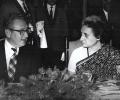
'She was brave. She didn't care a hoot. And India was not the strongest of nations as it is now.'
'She was brave. She didn't care a hoot. And India was not the strongest of nations as it is now.'
'If Pakistan's army wants to escalate violence in Kashmir, they have an unlimited supply of jihadis they can train and send. That's not an issue for them.'

A lawyer was killed on Tuesday during clashes between the security personnel and followers of a Hindu community leader, who was denied bail and sent to jail by a court in the port city of Chattogram in Bangladesh, police said.

'My father died in the liberation struggle. Bangladesh is our Motherland. This is home,' says Monindra Kumar Nath, a Hindu who has lived his 74 years in Dhaka.

Bangladesh is in turmoil, which is not good news for India, which shares a porous 4000 km border with it. There is a danger of fundamentalism growing there, and India has to move in to reset its ties with the new dispensation before China and Pakistan make capital out of it, alerts Ramesh Menon.

'Bangladesh has become unstable and this instability will impact India.'
Bangladesh descended into chaos on Monday as Prime Minister Sheikh Hasina surreptitiously resigned and fled the country in a military aircraft while the Army stepped in to fill the power vacuum.


Videos on social media showed protesters climbing a statue of Hasina's father Sheikh Mujibur Rahman, a 1971 Liberation War hero, in Dhaka and smashing it with hammers.
As news of Hasina's departure spread, hundreds broke into Hasina's residence, vandalising and looting the interiors, providing dramatic expression to the anti-government protests that have killed more than 100 people in the last two days. At the centre of people anger is the Hasina government's controversial quota system reserving 30 per cent jobs for families of veterans who fought the 1971 liberation war. With volatile crowds taking to the streets -- some clambering on Hasina's father and Bangladesh founder Sheikh Mujibur Rahman's statue and smashing it with hammers in a lasting image underscoring the fickleness of history -- Army chief General Waqar-uz-Zaman announced that the 76-year-old prime minister has resigned.

'The dominance of her party also meant that the institutions became lopsided -- whether it was the bureaucracy or the courts or the military.' 'She centralised power to the extent that you would see her representatives or her party office bearers having overly represented in these institutions.' 'That perhaps would have been the biggest blunder that she committed.'

Glimpses into the life of Aseefa Bhutto Zardari, who at 31, is Pakistan's youngest first lady.
'At this moment you cannot give her asylum because if you do, then you are directing public anger against India.'
Dr Manmohan Singh is the woolly-headed idealist ready to make any sacrifice to woo Pakistan quite unmindful of its inimical mindset vis a vis India, feels former Deputy National Security Adviser Satish Chandra.

Sheikh Hasina was on Thursday sworn in as the prime minister of Bangladesh for the fifth term, days after her Awami League won an overwhelming majority in the general elections boycotted by the main opposition Bangladesh Nationalist Party (BNP) and its allies.

A new logo, colour and tagline were unveiled last month.
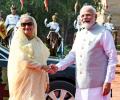
This is possibly the first time Hasina's daughter will be by her mother's side during an official visit to close neighbour and ally India, and analysts believe this to be significant in many ways.

If General Asim Munir, Pakistan's new army chief, wants to help defuse the current polarised atmosphere and shepherd civilian politicians towards negotiations on an acceptable date for elections, he may need to distance himself from any perception of needless hostility to Imran Khan, explains Rana Banerji, who headed the Pakistan desk at RA&W, India's external intelligence agency.

Mr Modi might have questions to ask himself on the most formidable strategic challenge before India that he inherited from the United Progressive Alliance: The triangulation between China and Pakistan. The failure to break out of it, or even loosen it a bit, is something to reflect on, notes Shekhar Gupta.

Chastened by the Kargil conflict, Pervez Musharraf will be remembered for gradually lowering the profile of terrorism and seeking a realistically negotiated settlement to the issue of Jammu and Kashmir, notes Ambassador G Parthasarathy, who served as India's high commissioner to Pakistan when Musharraf seized power in a coup in October 1999.

The timing of these transfers, while being projected as routine, is significant in both strategic and political terms, asserts Rana Banerji, who headed the Pakistan desk at the Research and Analysis Wing, India's external intelligence agency.
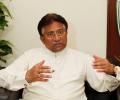
Learning perhaps from the Kargil debacle, Musharraf tried hard to evolve as a statesman in his dealings with India, recalls Rana Banerji, who headed the Pakistan desk at RA&W.
Seeking to give a new dimension to bilateral ties, Prime Minister Manmohan Singh Tuesday said "a strong and prosperous" Bangladesh is in the interest of India and the region.
 © 2026 Rediff.com - Advertise with us - Disclaimer - Privacy Policy - Sitemap - Feedback - About us - Terms of use - Grievances